
When the Aztec Eagle Began Her Soar Over Bridgeport (Part 3): Men of Maplewood (1990-2000)
By Abraham Lima
To read the previous articles, use the guide below to navigate.
- Part 1 – https://bportlibrary.org/hc/hispanic-populations-and-culture/when-the-aztec-eagle-began-her-soar-over-bridgeport-part-1/
- Part 2 – https://bportlibrary.org/hc/business-and-commerce/when-the-aztec-eagle-began-to-soar-over-bridgeport-part-2-from-puebla-york-oaxakeepsie-and-mexchester-2/
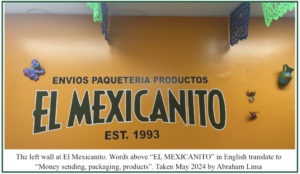
“I don’t remember the year they [the first Mexican businesses] opened, it was in the 90s. When I arrived [in 1988]after a few years, the first Mexican restaurant that opened was La Poblanita and La Flor de Mexico Bakery, then El Mexicanito, and then later La Guelaguetza [Grocery] and Garibaldi.”
|
When The Aztec Eagle Began Her Soar Over Bridgeport: Part 1
By Abraham Lima
PROLOGUE:
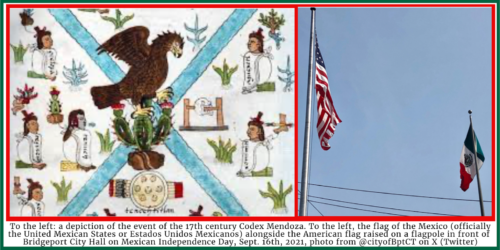
The eagle eating a cactus perched on a snake was the symbol the god Huitlolopotchli gave to nomadic Nahuatl-speaking people as to where to build their new city. They found just that in the middle of Lake Texcoco and thus the city of Mexico-Tenochtitlan arose in the middle of the lake with artificial islands surrounding it.While the Aztec empire did not territorially incorporate all the land of modern Mexico, it is the Aztec eagle from the people that called themselves the Mexica (me-she-ka) that is the symbol of the nation state that adopted for itself the name of these Mexica, or as the Spanish called them, Indios Mexicanos, who gave the land the name, Mexico. (more…)
When the Aztec Eagle Began to Soar Over Bridgeport: Part 2 (1950-1990)
by Abraham Lima
This is Part 2 of a 5 Part Series at the Bridgeport History Center:
For Part 1 click below: https://bportlibrary.org/hc/hispanic-populations-and-culture/when-the-aztec-eagle-began-her-soar-over-bridgeport-part-1/
For Part 3 click below: https://bportlibrary.org/hc/business-and-commerce/when-the-aztec-eagle-began-her-soar-over-bridgeport-part-3-men-of-maplewood/
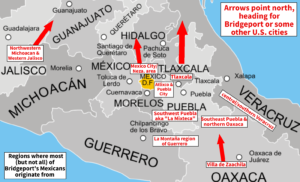
How did Bridgeport’s Mexican community arise?
It came about with a few separate chance incidents.
A Few Early Arrivals: The Carmonas and the Solies
There were few Latinos in 1950s Bridgeport as the first wave of Puerto Ricans and Cubans was kickstarting. However, about a dozen or so Mexican individuals ended up in Bridgeport and integrated into that young Puerto Rican community.
An example is Guillermo Carmona, born 1921 in Tepeaca, Puebla. He and his Dominican bride, Rhina Ligia Carmona, settled in on Iranistan Ave. The son of an indigenous woman and a white Mexican man, he had an 8th grade education, higher than average for 1950s Mexico. Carmona later moved to Stratford with his wife and 2 sons, and in 1963 had a daughter, Maria Carmona.
Maria recalls “My dad and mom (a Dominican) moved to Bridgeport in July 1954. They went to Bridgeport because my dad had finally found the type of work he had wanted to find when he first arrived in the U.S. The place was Stanley Works, a steel mill [which later became Carpenter Steel, a major city employer]. My father had worked at a foundry in his hometown of Cholula, Puebla and, so, he was a skilled laborer. It took him about 8 years to find that work after living in New York City and working all kinds of jobs, learning English, figuring out how to make his way.”