When the Aztec Eagle Began Her Soar Over Bridgeport (Part 3): Men of Maplewood (1990-2000)
By Abraham Lima
To read the previous articles, use the guide below to navigate.
- Part 1 – https://bportlibrary.org/hc/hispanic-populations-and-culture/when-the-aztec-eagle-began-her-soar-over-bridgeport-part-1/
- Part 2 – https://bportlibrary.org/hc/business-and-commerce/when-the-aztec-eagle-began-to-soar-over-bridgeport-part-2-from-puebla-york-oaxakeepsie-and-mexchester-2/
“I don’t remember the year they [the first Mexican businesses] opened, it was in the 90s. When I arrived [in 1988]after a few years, the first Mexican restaurant that opened was La Poblanita and La Flor de Mexico Bakery, then El Mexicanito, and then later La Guelaguetza [Grocery] and Garibaldi.”
|
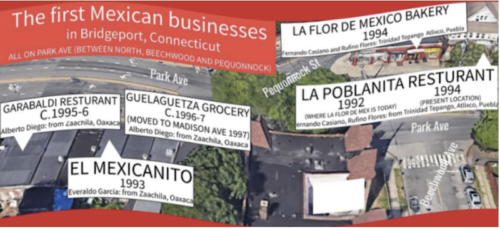
Mexican businesses first opened in the early 1990s, all clustering on one intersection.
Starting about 1989, Rufino Flores’s uncle, Fernando Casiano, a cook in Queens, NY, would come to visit his nephew and began to sell tamales to fellow Mexicans they knew in Bridgeport.
“Fernando came with his little pot of tamales, he lived in New York. He would come to my house and ask me if there were any other Mexicans.”
His nephew would tell him: “Well there are no Mexicans here”. And I would take him, and they [the clients] would tell him where other Mexicans they knew lived, and then those clients would tell him the same. “When I saw him, he had already sold here, he sold over there.”
Casiano sarcastically asked Flores, “What happened to there being no Mexicans over here?”.
From here, Flores had a realization.
“There I began to realize that there were Mexicans [in Bridgeport]… people who came in the 70s that we didn’t know about. But they all came out for the tamales.”
In the words of the tamale salesman himself:
“House to house… the entire city. Of course, where there were countrymen… it’s a lot of streets, I don’t even remember the names anymore. Where there were Mexicans”.
And exactly how many Mexicans would that be?
“Put it at, some 500…
As I repeat, when we arrived there was not much of a Mexican community, well you know, we are used to seeing our people. Yes, there were Hispanic people, but more so they were Puerto Rican. There were a few Central Americans, but few…”
But one day, an opportunity would change their lives.
“I started selling tamales, bringing them from there to here, and I saw that there were no Mexican businesses, we are talking about ’89 and ’90. And I encouraged my nephew to open a small business together there on Park Avenue because I saw that it was a concentration of… more than anything, Hispanics. I think that there were not only Mexicans, of all nationalities, who were always seen there, in front of the market.”
One morning, Rufino Flores was at the Park Ave & Pequennock St bus stop, on his commute to Frankie’s Diner, when he noticed a for rent sign on a storefront. The owner showed him around.
“The property: it had everything, its own kitchen…”. The man said, “If you want it, it’s $760”. I made $150 at the diner… On Saturday when Fernando came, I told him, ‘They are renting a place on Park Ave. And he said, “Let’s go see it”.
They found a well connected Puerto Rican lawyer. She was a friend of local Puerto-Rican activist Rosa J. Correra, who helped navigate the health inspection system, and anything related to local government.
“I told Fernando I needed to go work at the diner”. Fernando convinced him to leave his job at the diner and open the restaurant.
The current owner of Frankie’s Diner, Nick Rousass, recalls the ordeal well. “Rufino Flores used to work here when I was a kid. He left to start La Poblanita… that was the first Mexican restaurant in Bridgeport”.
With some help from a Portuguese-American coworker (married to Antonio, a fellow immigrant from La Trinidad Tepango) they got to work. In her words:
“Rufino worked here for a long time, and I went to help him at La Poblanita too. Because before they opened there were no Mexican stores or anything. The closest thing to Mexicans was Casa Grande because it sold Mexican products. But like now? Nothing, nothing! It was Mr. Fernando who was the first.”
But the biggest challenge for the duo, besides “lack of resources”, was that they had never worked in the Mexican food business before. In fact, they went around visiting restaurants to get an idea of how food was served. “If they prepare it like that, why can’t we?”
Tacos La Poblanita opened around 1992 at 1666 Park Ave. The work of the 41-year old tamale-man, with nothing more than a 3rd grade education, and his diner cook nephew. An homage to their homestate, La Poblanita translates to “the little woman from Puebla”.
It was an instantaneous, resounding success.
In Antonio’s words: “All the time. La Poblanita? It was- It was packed.”
His wife interjected, “It was the only Mexican restaurant. Americans came. They came from Westport. They came from Norwalk. A lot of people came. It was always packed.”
However, most of the clientele were local Mexican immigrants, more arriving day by day.
Part of the success was that the Mexican community was still overwhelmingly single, working-age men. Fernando Casiano put it like this:
“At first, it was all men who lived over here. That’s why we had that opportunity because they didn’t – they had to go and look for somewhere to have dinner, somewhere to have breakfast. Since they were, then, there were only single people, they hadn’t brought their families yet. There were [families], but only two percent, one percent. They arrived later.”
Maria Carmona recalled how “my mom and dad considered La Poblanita the first [Mexican restaurant]. The deal on Tex-Mex as I see it is that it was more recognizable (and less foreign) as a cuisine back then than many other types of Latin food because it had a US connection and was already somewhat familiar. Plenty of Americans operated Tex-Mex restaurants.
Locally, there was one in Stratford for years, and we hated it. Tex-Mex was nothing like the amazing Mexican food we knew…[Carmona’s parents] always said La Poblanita was the first.”
Even ex-mayor Bill Finch credits La Poblanita as his first encounter with Mexicans in Bridgeport.
“My first recollection of Mexicans in Bridgeport was La Poblanita. At the time I was on the city council.” A fellow city council official had told Finch that there was a Mexican restaurant in town. “Mexican? In Bridgeport?” I knew we had a large Puerto Rican community, but I had never thought of Bridgeport as a place to get Mexican food.”
“Unfortunately,” he recalled, his palette was not suited then to the spice of Mexican food.
Don Gregorio’s daughter (see previous article) recalled they would get Mexican items in those days from “a Mexican truck… came in maybe after 5 years since we were here. There was a van, there was a guy that used to come in from New York, he used to come in between like 10 to 12 or 2 o clock, he used to stop by your house. I don’t remember how we got in touch with him. So he was going around Bridgeport, and if you missed him, you were out of… like basic stuff, tortillas I don’t know, chiles… He came here from New York, and he was just going and if you missed you were like “Oh, missed him, until next week!
He used to bring stuff, he used to bring CDs back in the day… started bringing like little Mexican candy, and you know like, Gansitos [a Mexican brand of pastry snacks] and stuff like that. We used to love him because we didn’t have anything [Mexican].”
Gloria Flores Huerta recalled in the late ‘80s and early ‘90s “there wasn’t even masa to make tortillas… the Mexican stores started to open… La Flor [de Mexico], another on Park Avenue [El Mexicanito]… they all started to open at the same time.”
It was 1993 when the first Mexican grocery store opened in Bridgeport.
El Mexicanito Grocery opened right across the street from La Poblanita Restaurant at 1681 Park Ave, the work of an immigrant from Villa de Zaachila, Oaxaca named Everaldo Garcia Juarez.
His Bridgeport-born son, Omar Garcia, runs the business today. He tells the story like this:
“My parents arrived in 1988 but in Poughkeepsie… he [Everaldo] wanted to open a store, but he had friends in Poughkeepsie and didn’t want to compete with them, so he passed by over here and he sold from his car…. He would go to houses to sell, they would tell him “aquí hay paisanos, aquí hay paisanos” [“there are countrymen here”] all the way to Massachusetts”.
He would pass by at night, when local Mexicans were returning from work in the restaurants.
In his father’s words: “business brought me to Bridgeport, we were selling [Mexican products] and here we came to sell, house by house… I started it on this street because it was busier. There was no McDonald’s or anything in front here. There was a store called Waldbaum’s. And that was where most of them came to shop. So there was more traffic of Mexicans in this area. And there was La Flor de México and La Poblanita already.”
The store itself started off selling Mexican goods brought in by Everaldo from Passaic, NJ.
La Poblanita’s move to a bigger location down the street. In her old location, the pair opened a Mexican bakery, La Flor de Mexico, that same year of 1994. It is the oldest-running (and likely the first) Mexican bakery in all of Connecticut.
Why the name? Casiano explained how “since we wanted to sell sweet bread, over in Mexico “La Flor Bakery is very famous where we are from, and so for that reason we… named it that”.
Rufino Flores told how “I wanted to make it a bakery even though I didn’t know how to make bread… Someone from Oaxaca came along who knew how to make bread. “Don’t worry. You already have your baker. It’s me!” The first day he made bread, there wasn’t enough.” The baker told him, “My countrymen are telling me they want bread, but I don’t have any more bread.” Rufino said “Well, make more”. The baker responded “but that will take time!”
To quote Jose Lucero: “The first Mexican bakery around was La Flor de Mexico, the one on Park Ave, the only one. We used to go there to buy bread, because who else made it? Nobody!”
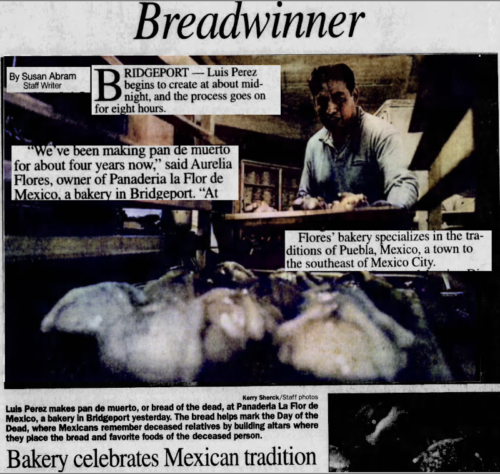
Collage of clips made from “Bakery Celebrates Mexican Culture” Stamford Advocate, 11/1/2001
Helping them was Francisco “Panchito” Rodriguez. He arrived in 1968 from Mexico City and lived on the East Side, working as an electronics technician. His daughter Rosalinda recalls: “Don Panchito was my dad. He passed away 2 years ago. I remember he helped with designing the early menus. I tagged along with him a lot to La Poblanita and La Flor de Mexico bakery.”
Some, like Alejandro Lima (from Tehuixtla, Puebla) came as far away as Port Chester, NY.
“I started working for the city of New Haven [Parks and Rec.] and on the way back we would go to Bridgeport to drink and we would go there to eat at that restaurant. Later, they brought in Mexican karaoke to sing and it became famous… people came from other places to eat there.”
In 1986, Lima brought a dozen or so Poblanos to Port Chester, on behalf of his Stamford-based employer: Designs by Lee. Some later worked with him in New Haven, and a few of them (from Tehuitzingo, Puebla) moved to Bridgeport in the 1990s, hired by a local landscaping company.
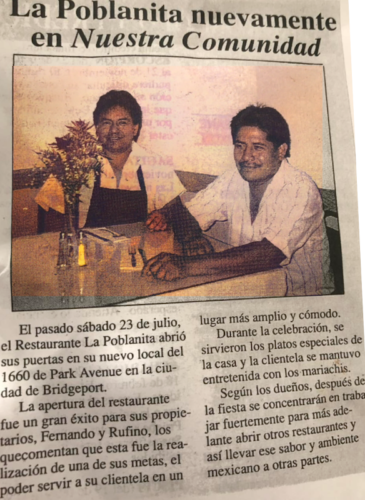
Left: The article written by Francisco Rodriguez about La Poblanita. English transcription below.
Right: A July 1994 Connecticut Post article mentioned La Poblanita by columnist Charles Walsh
| The title translates to “La Poblanita Once Again in Nuestra Comunidad”. The article reads:
“This past Saturday, the 23rd of July, La Poblanita Restaurant opened its doors in its new location on 1660 Park Avenue in the city of Bridgeport. The opening of the restaurant was a great success for its proprietors, Fernando and Rufino, who commented that this was the realization of one of their goals, to be able to serve their clientele in a more ample and comfortable place. During the celebration, the house specials were served and the clientele were kept entertained with the mariachis. According to the owners, after the party they will concentrate on working hard to later on open other restaurants and like that bring that Mexican flavor and environment to other places.”
|
Meanwhile, Evaraldo Garcia of El Mexicanito saw more from his hometown settle in Bridgeport, including his cousin, Alberto Diego, (the first person from Zaachila to settle in Poughkeepsie). Many other Zaachileños came from Poughkeepsie, like Miguel Angel Hernandez. He “arrived in ‘98, and by then many from Poughkeepsie had emigrated to Bridgeport… our countrymen who worked in the diners, many of them later started their businesses and companies.”
Two years after moving here from Poughkeepsie, Alberto Diego opened Restaurant Garibaldi in 1997 at 1701 Park Avenue, in the same plaza his cousin operated El Mexicanito Grocery.
It wasn’t the first Mexican place, sure, but Garibaldi was the first Oaxacan restaurant in town. Foods like tlayudas, unique to Oaxaca, shared the menu alongside typical tacos and tortas.
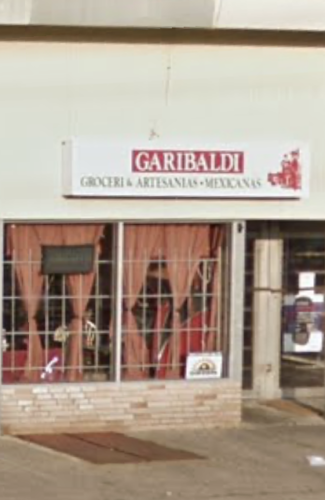
LEFT: A June 15, 1997 ad for Restaurant Garibaldi in the Connecticut Post
RIGHT: A June 2011 Google Street View photo of Restaurant Garibaldi
Black Rock was still void of Mexican businesses, besides the Peruvian-owned Taco Loco, which served more Americanized cuisine rather than what the incoming Mexicans were used to.
Then along came Jose Bravo Flores, a restaurant worker at Pancho Villa’s in Westport. He arrived in the 1980s as a 12-year old in the Bronx and immediately got to work washing dishes full-time. He was from Jilotepec, Guerrero, in that state’s Montaña region, bordering Puebla.
It was Gloria Flores Huerta and her family, from Tulcingo, Puebla (next door from his hometown) who got him the job in Westport and he came in 1991. Wishing to start something of his own, in 1995 he opened Taqueria Mexicana at 2810 Fairfield Ave in Black Rock.
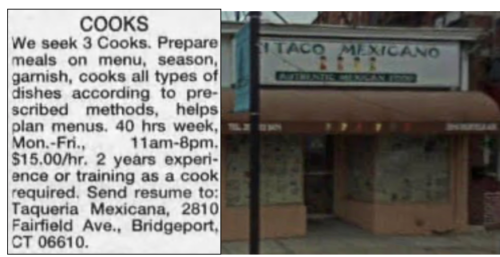
Left: Ad for workers by Taqueria Mexicana from 9/16/2001 in the Connecticut Post
Right: Taqueria Mexicana’s old location in 2008, by then another Mexican place (Google Maps)
Gloria Flores Huerta herself got entrepreneurial, opening up a place on Main St near North Ave. It was a small branch location of Taco Loco in Black Rock (owned by Peruvian Miguel Tomasio).
Her daughter-in-law Lizzath Vibaldo mentioned that Gloria “said that she entered into a partnership with the owner and she opened a second taqueria, which was more like a small locale with a couple of tables. This was open around the early 90’s.”
Her son, Jose Lucero, began making trips to New York to buy Mexican items. “When I got married, I decided to buy a minivan. I used to sell tortillas, cheese, and other Mexican products. I’d go to people’s houses for deliveries, and I’d drive through Norwalk and Bridgeport”. His mother continued the venture, buying from a relative’s store in the Bronx to resell in Bridgeport.
School Life:
Jose Lucero attended high school from 1987-1989. “I went to Harding High School. I started high school there when I moved from New York. I played soccer; I loved it.”
With Lucero a part of the roster, Harding soccer team became city champions. He studied alongside Puerto Ricans, Colombians, and a melting pot of other peers. Mexicans were rare.
“There was a Peruvian, I was the only Mexican male, and there were the daughters of Mr. Cirino, also Mexicans. We would hang out together, we were three Mexicans and a Peruvian.”
The story of the Luceros and Mr. Cirilo can be found in Part 2. All the while, Lucero continued to help sustain his mother and siblings. “I worked as a busboy in Pancho Villa at 5 pm. I went to school from 7 to 3, and then I would catch the train in Bridgeport and take the train to Westport.”

Clipping from the CT Post article “City Soccer Melting Pot of Tongues, Styles”. 9/21/1990
After high school, he got a grant to try-out for the New England Revolution (of the newly-formed MLS), but after the league announced to wait until next year for new roster openings, Lucero couldn’t stay in Massachusetts and returned to Bridgeport to economically sustain his mother.
At this time, local Mexicans also formed a team in the Bridgeport Independent Soccer League, playing against teams like Colombia, Bridgeport Italians and Vasco da Gama at Seaside Park.
Harding High School had hosted the city’s bilingual education program since the 1970s. While most students were Puerto Rican or Southeast Asian, there were a “number of students… from Honduras, Colombia, El Salvador, Mexico” and other places as early as 1983 (CT Post article).
Don Gregorio’s daughter also went to Harding in the mid 1990s; having started 7th grade at Blackham School when she arrived from San Bernabe, Puebla in 1992. She recalled how “there were two Mexican kids in Harding, in the whole school”, it was her and a boy from Mexico City.
“In elementary school, it was just me and my cousin, the only Mexicans in Blackham, and my other cousins went to another school, and they too were the only 2 Mexicans in another school..
It was different for us; everyone was Puerto Rican or White and Black. We were the outsiders.
When I was in school in my class, it was a lot of Puerto Ricans, there was only one Salvadoran, one Dominican, and me, the Mexican. It was like, everybody knew the Mexican. “You talking about the Mexican? I know her.” Because I was the only one. “You know the Salvadoran?”
It was just like that. Same thing in high school. Then there were 3 of us, and that’s it. You could point to, you know, who was not the Puerto Rican…
I would get along with Puerto Ricans, but it’s like you know, you don’t speak the same way… Like they have different traditions, different ways of seeing life, you know?”
She said that she still reminisces with her cousin about life back then.
“My cousin still remembers “Remember when we were the only Mexican kids in school. We would take the bus, we were the 2 Mexicans, and you couldn’t miss us”. Here on this street [Fairfield Ave] my little cousins would wait for the bus. And people would say “I saw all these little Mexican kids waiting for the bus” and I’d say “Yes, they’re my cousins!”
Her classmate from Mexico City might have been Jose Antonio Moreno. According to a 1993 article, he arrived in 1991 with his family and helped his father in the house painting business.
Jose Lucero’s younger brother, Rene Vibaldo, was born 1987 in Park City Hospital. He recalled that being Mexican was a novelty at Roosevelt School in the 1990s.
His wife Lizzeth remembers, “my husband said that when he was in school, he was bullied a lot by the Puerto Ricans because he was Mexican. He got into a lot of trouble because of that. They would call him beaner, he didn’t know what that meant… He went to Bullard Havens”.
Rene Vibaldo shared his experience like this: “It was Blacks and Puerto Ricans. There weren’t even any Brazilians here. I know in elementary school I would get picked on… It was like 7th grade “You like tacos, or “You like beans”. It was more the food that we would eat, the mariachi, Speedy Gonzales. Looking back, yeah I like tacos, I like beans, they’re delicious. But I was in middle school then. The only way I would try to bond was with music. Growing up in my household it was Los Bukis, Luis Miguel. But I would never listen to that in school. I’d listen to Hip Hop, I would dress like Hip Hop, you know, with the baggy pants… Like I said it was 4 of us in total, 1 girl and 3 boys. I was the only one in my grade that was Mexican in Roosevelt School”
In Ballard Havens, he had one Mexican friend, Edgar, from Tecomatlan, Puebla (near Tulcingo).
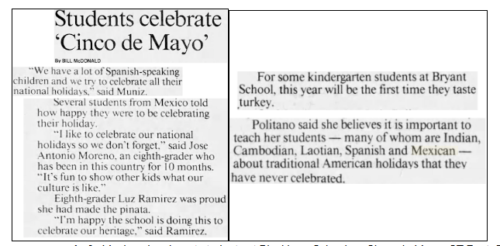
Left: Mexican immigrant students at Blackham School on Cinco de Mayo. CT Post, 5/04/1991
Right: CT Post article snippet “Taste of Turkey Will Be First for These Youngsters”, 11/26/1991
Born 1992 in Bridgeport, Evaraldo Garica’s son, Omar, felt a similar way. “We felt outnumbered, sometimes even made fun of… I went to Blackham School, Columbus School, and Central High School… in elementary it was probably like 4 [Mexican kids] maybe, middle school was probably a little less, and there were very few of us. High school was maybe 10… Even the music, there wasn’t much Mexican music like we hear today, on the streets we hear Mexican music, and before it wasn’t like that, it was mostly rap, reggaeton, and hip hop, and I grew up with that music because that was the only music that was in school.”
From Man to Man, Town to Town
In the words of Casiano: “The community was very small. The most recognized community that was there was from the state of Oaxaca, and later those from Puebla began to arrive”.
The number of people from Fernando and Rufino’s home village in Bridgeport was still small.
“Like about 20. They were already there a good while before me”. But their numbers grew fast.
Fernando recalled that back then…
“When I arrived here the majority were from the state of Oaxaca… I remember well everyone who helped us achieve all our dreams that we wanted to realize was the entire Oaxacan community. Right away you could hear their accent, and they told us their stories… they had arrived, like us, to work. They worked, or still work in restaurants, a bit in construction there were a few… At that time I knew that the Oaxacans were from Zaachila. Zaa-chi-la..”
Everaldo Garcia said the same thing. “From Puebla and Zaachila, the majority. The majority, if you ask around, the majority from Oaxaca is from the municipality of Zaachila. There are many, many people [in Bridgeport]… most of them only restaurants, only diners. They hardly worked in other jobs. There was a small group from Mexico City. We were all very well known [to each other] because most of them used to sit here on the corner [of Park and North] to talk, that’s why we knew there were people from Mexico City, from Puebla, and from… Querétaro.”
Edgar Ojeda, a Zaachileño who came in 1996, quipped that “a man once said, Bridgeport is like another Zaachila. Everytime I come to Bridgeport, I feel like I’ve arrived in Zaachila!”.
The main employers of Mexicans that Casiano recalls are still “all open today. Colony Diner, Frankie’s, Andros Diner, Dutchess”.
As stated, a few found jobs elsewhere. The state death index lists three young Mexican deaths around then. First a landscaper who died in 1990 who lived on Beechwood Ave, a second was a mechanic helper at an auto shop who lived on Center St and died in 1993. The last was a cook.
Casiano said Mexicans then clustered on one street in particular: “Typically, the famous street that I knew before was Maplewood. Those areas were very well known to the Mexicans. That street there were three, four apartments, and everyone was just purely Mexican… Some were in Maplewood and I think Iranistan, that area had the most, and others lived up over by East Main, but it was very minimal. Yes, everyone concentrated more on this area by Park Avenue ”
Garcia recalled similarly. “There was a house near La Poblanita. That one was full. There were [Mexicans] on Howard Avenue, East Main near Boston Ave… That’s where there were most.”
Soon, many arrived from a cluster of small rural towns between Atlixco and Puebla City. They include: Santa Clara Ocoyocan, San Bernabé Temoxtitla, and Santa Martha Hidalgo.
Carolina and her husband arrived in Bridgeport in 1996 from San Bernabe Temoxtitla. Her sister is married to Don Gregorio. “There weren’t many people from either San Bernabe or Mexico.”
Carolina began working at a Ramada Hotel in Stratford, then at various North Main Street stores. Her husband worked at a Chinese laundry in Westport. With a lack of Mexican products, she began selling them door to door and got her brother-in-law, Gregorio, in on the business. He began to make and sell his homemade Mexican cheeses and Mexican sausage (called chorizo).
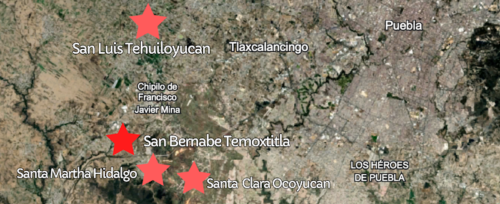
4 towns with large populations in Bridgeport, from Google Maps, edited by Abraham Lima.
The community from San Bernabe Temoxtitla has exploded, Carolina said: “There were about 30 people from San Bernabe… they were few! We all knew each other… “This is my uncle, my cousin, my brother, my brother-in-law”. And from there we brought everyone here, from San Bernabé to Santa Marta, Santa Clara and San Luis… now the whole town is in Bridgeport”.
Someone who followed the trail is the man behind a Black Rock taco truck, Tacos Meli. He left Santa Martha Hidalgo for Bridgeport in 1998, among the first of hundreds to follow. Back then:
“I saw that more were coming from other nearby towns. San Bernabé, San Gregorio, Santa Isabel [Cholula]. Here I saw that there was more from San Bernabe.”
Among the first people Don Gregorio invited to Bridgeport was a brother-in-law from the nearby village of San Luis Tehuiloyucan, Puebla. He didn’t know the ripple effect it would cause.
“I spoke to him and when my brother-in-law arrived here, after a year or two, he helped his brother. From there he brought his family… amongst themselves they helped each other”,
The numbers from San Luis Tehuiloyucan grew quickly.
One such man came in 1999 from San Luis Tehuiloyucan because his brother was already in Bridgeport, working at Pombal Bakery. “As he knew about baking, someone told him that there was work here and it paid better than in New York… I was in New York first. I went to Bridgeport later because of my brother… a Portuguese bakery. He had worked in an Italian bakery in New York, so making bread was not difficult for him”. Back then, he said, they were very few.
Ms. Aca, a Bullard-Havens graduate, recalls her parents left San Luis Tehiloyucan for Bridgeport around that time too. “For my mom it was 22 years ago [in 2002] and my dad 26 [in 1996]. My mom worked at a factory for pasta, you know, food, and my dad works as a landscaper right now. Some of my family was already here, that’s why my parents came.”
Only 40 minutes away from San Luis Tehuiloyucan is the Mexican State of Tlaxcala.
Fernando Casiano recalled, “Right now I know, more more, those that began to arrive were those from Puebla, Oaxaca, Guerrero, and later on the ones from Tlaxcala began to arrive.”
Tlaxcalan immigrants clustered in New Haven in the late 1980s, arriving from New York City.
Many also came from Eastern Puebla (near Veracruz) from one town near Tlacotepec, Puebla. To quote Veronica Huitzil, “there’s a lot from Rancho Los Marias… many of them have the last name Maria”. One Black Rock man from there recalled how his brothers brought to New York from California in the late 1980s to work landscaping. They had moved to Bridgeport by 1995.
Nick Roussas of Frankie’s Diner is aware of the regional makeup of his workforce. “I’ve heard of Zaachila. The people who worked in this diner were from Oaxaca, Guerrero, and Puebla. Those three states. The guys from Guerrero speak a dialect called Nakua, something like that.”
Emerging from the Mountains:
Most Guerrenses (people from Guerrero) in the Tri-State are from the Montaña region bordering Puebla. One of Mexico’s poorest regions, they followed the Poblanos to New York in the 1980s. In Bridgeport, most Guerrenses come from one tiny village: Alpyencancingo de las Montañas.
Fernando Casiano recalls how “later came those from Guerrero [started coming]because there were already a few, by 94’ – 95’ there were by then a lot of people from Guerrero.”
Salvador, who came to Bridgeport in 2001, explained: “My town is called Alpuyecancingo. There are some from Pochutla, Guerrero… close to my town and Zacualpa, bordering my town.”
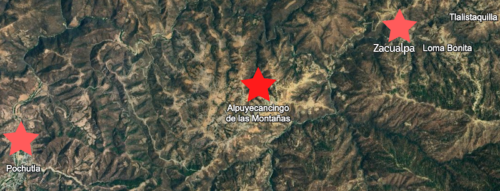
In 1980, Alpuyencancingo was a village of some 895 souls. Only 15 adults in town could read or write then. There was no electricity, running water, television, cars, or telephones (though 79 of them did have radios). Nearby Pochulta didn’t have numbers that dire, but they were still grim.
That’s where it all began. “In our town there is no money and they come here.”
Perhaps it started when Compare Supermarkets opened a store on East Main St in 1991. The first owners had brought 4 Mexicans “from Guerrero and Puebla” from NY to work. Either way, Guerrense migrants found a niche in Bridgeport-area supermarkets, where most work today.
But Cruz, who came in 2010, said instead that “I only know that those from my town here came directly to Bridgeport… Those from my town began to arrive in Bridgeport in 1998… The truth is because there is no work there and because we discovered that more money is made here”.
They stand out from other local Mexicans in one way, their daily language. In Salvador’s words: “They speak Nahuatl. Everything in Zacualpa is [also] Nahuatl. Except in Pochutla, they don’t speak Nahuatl, only Spanish. But in Alpuyancancingo and Zacualpa, they speak Nahuatl.”
Nahuatl was the language of the Aztec Empire, and it’s still the main language in that region.
How many Nahuatl speakers? Cruz simply said, “A lot! Almost my entire town is in Bridgeport.”
In 1980, 27% of Alpyencancingo (15 and over) couldn’t speak any Spanish, and 72% were bilingual with Nahuatl. In Pochulta, only 4 people didn’t speak Spanish, and few spoke Nahuatl.
Salvador continued: “The children no longer speak Nahuatl, only Spanish… The adults speak Nahuatl since they’re older. What is certain is that we learned [Spanish] when we were older… The little kids [now] already speak Spanish since they’re little.”
This already happened a century ago in Central Puebla, once a very Nahuatl-speaking region.
In Teodora Campos’ words: “My mom is 83 years old, and she still speaks Nahuatl. But not us anymore, us over in Atlixco, the language they spoke before was Nahuatl, my grandparents spoke Nahuatl. That was the language. But now you hardly hear it anymore, only Spanish.”
Even Fernando Casiano grew up speaking Nahuatl, “it’s what my mom spoke with me”. In the past, many employees of his still spoke it. “A man worked here about 4 years ago and I heard that he spoke to his relative in Nahuatl. But he spoke to him very differently than we do.”
Reina, Gregorio’s wife, is also fluent in Nahuatl. Their daughter recalled “My mother speaks Mexican [another word for Nahuatl]… She learned it just by listening to her grandmother.”
One early migrant from Alpyencancingo is Cristina Bautista, who also speaks Nahuatl. Her son was among the 43 kidnapped students from Ayotzinapa, a major Mexican national tragedy.
In 1999, she followed her husband, Miguel Asensio Tapia, to Bridgeport, where he had settled earlier. She worked in fast food, a pizzeria and a car wash (as said in the book “La Traveria de las Tortugas”). Today she is an activist in Mexico, demanding answers from the government.
Nick Roussas recalled that people from Guerrero, “I wanna say they started coming here late 90s, early 2000s.” He recalled that at Frankie’s Diner, “We had one or two Mexicans from other states [besides Puebla, Oaxaca, and Guerrero], but they didn’t last because they didn’t fit into the social cliques… Michoacan was one, and Sinaloa”.
Michoacanos arrived in Bridgeport via Norwalk and Westchester County (more in next article).
From the Dishwasher, to the Machine Operator, to the Grocer:
In 1997, Alberto Diego, owner of Garlibaldi, opened Guelaguetza Grocery. It was originally in the same plaza as El Mexicanito and Garibaldi Restaurant on Park Ave. Alberto and his wife Luisa soon after moved the grocery to 819 Madison Ave, then a largely Italian neighborhood.
A “guelaguetza”, which in the Zapotec language means “giftgiving”, is a yearly indigenous Oaxacan festival done throughout the towns of the Oaxaca Central Valley, including Zaachila.
That year, Osesimo Aguilar (among the first from La Trinidad Tepango, Puebla to settle here) opened Two Dollar Pizza House, a New England Greek-style pizzeria and eatery on 976 Park Avenue between John St and Fairfield Ave. It was renamed Five Star Pizza House in 2004.
He was just the first of many Mexican ex-employees of Crossroads Pizza to open a pizzeria. A longtime employee, Gonzalez (from Tlalalcaleca, Puebla) who came to town in 1992 thanks to a friend from Tepango, said his boss learned “working with Greeks, they taught him everything … [at] Crossroads Pizza. It wasn’t Five Star Pizza before, it was called 2 Dollar Pizza. It was called 2 Dollar pizza because this little box said “$2” on top… in those times inflation was less.”
A year later, Fernando Casiano opened yet another place: Azteca Restaurant and Bar, on Main St in downtown Bridgeport, the site of the former Ocean Sea Grill. His family moved upstairs.
Everaldo García recalled that many Mexicans he knew began working in non-restaurant jobs in the late 1990s, like in factories. “There was one here at the corner of Fairfield Ave and I-95, there was one where they made pasta. And there was also one where they made screws.”
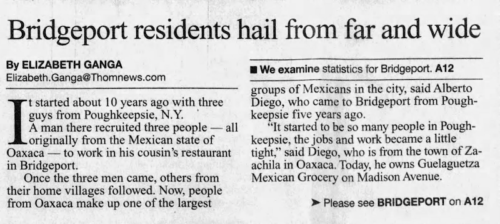
Front-page CT Post story on 3-14-2000 titled “Bridgeport Residents Hail From Far and Wide”. Starts off with the story of the first Zaachileños in Bridgeport, as told by Alberto Diego.
That factory was the Pratt-Read Tool Company factory at 1155 Railroad Avenue (between the railroad and I-95). One of the last local factories to close, it left in 2007. According to the Connecticut Post, it still had 170 employees and made 100,000 screwdrivers daily in 2004.
“Pratt Read, a lot of Mexicans worked there!”, agreed Veronica Huitzil. She was born in Coronango, Puebla (not far from Tehuiloyucan), but raised in the Bronx. Her mother was told by a Puerto Rican friend that there were jobs in Bridgeport, and after many visits, Huitzil got a job in town and stayed in 1998. She worked at Pratt Read “making screws for Sears” but most of the Mexicans were no longer there (those with fake work permits were fired to avoid liability).
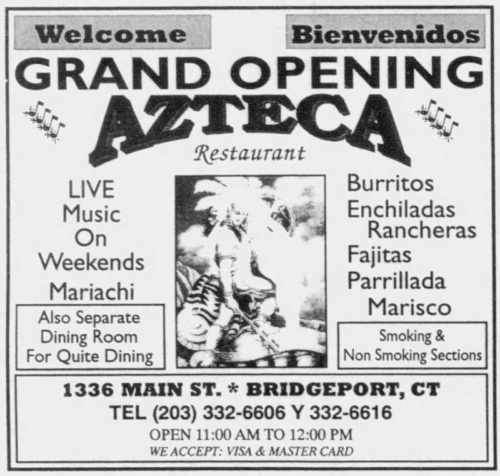
Two CT Post Ads: 12/31/1998 ad for Azteca Restaurant and 1/19/1997 ad for Two Dollar Pizza
Gregorio knew a lot of Mexicans in a nearby Pasta factory in Fairfield and around Shelton, where his cousin worked. “Mexicans worked in factories, the windows, the printing presses.”
Gregorio’s daughter recalled. “Yeah like the window factory. A lot of [Mexican] people. Her father added “from Puebla, Mexico City, around ‘95… [with workers from] San Luis, San Gregorio..”
His daughter cleaned the People’s Bank headquarters with other Mexicans and Puerto Ricans.
Gregorio recalled how many Bridgeport Mexicans he knew also worked in Westport’s fine dining scene, in upscale restaurants like “Pancho Villa or Sol Y Luna”, just like back in the 1980s.
Gregorio said of the work environment in Bridgeport for Mexican immigrants in the 1990s. “Before there was a lot of work. They walked out of the streets and shouted about work. You could work as anything in those days. There were jobs in restaurants [or]throwing asphalt. It’s not like now where you have to take better care of your work.”
Antonio’s wife, a Portuguese-American diner waitress, gave her observations of Mexican work life: “I never saw a Mexican who was on the welfare line to ask for help. They worked here where they were wanted. They came with their children and they worked. They were good workers. Not because I’m married to a Mexican, the truth is the truth. Hard workers.
They worked 12-13 hours a day… The Portuguese were more into construction. The Italians too… The Mexicans, when I came, it was all more restaurants. They started as dishwashers, they went from dishwasher to cook. Some stayed. Others went somewhere else because they were offered something, because they were offered- they were given one or two dollars more.”
A Second “Little Mexico”: Black Rock
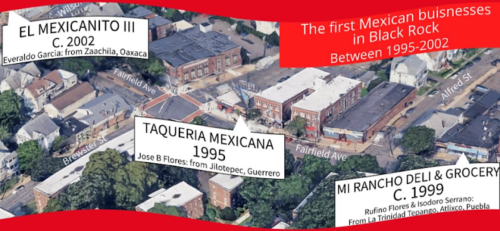
Black Rock grew into a second Little Mexico, rivaling the West Side. A block from Taqueria Mexicana, Rufino Flores and Isodoro Flores opened Mi Rancho Grocery and Deli around 1999.
Teodora Campos said “on Fairfield Ave, these buildings, this building that’s here nearby, there were many Mexicans. You’d say almost all from Puebla- Atlixco… the first ones that arrived brought their siblings, cousins, that’s why there’s a big community from Atlixco. Or sometimes between friends, they say “Well, give me a hand”, and then they’d start coming here like that.”
As Don Gregorio said “Those from my town and from the other [nearby] towns are on this side”.
Black Rock was safer, he said, and explained that gangs would target Mexicans since they often didn’t have legal status and thus were afraid to report assaults to police. “Before they assaulted them, they entered their houses. Before, since they would keep money under their beds…”.
Unfortunately, some of those gangs were composed of local youth, mainly African-Americans or Puerto Ricans. Some ethnic tension arose. Everaldo Garcia recalled the following: “The Puerto Ricans abused a lot of our ignorance, I say, of the fear that we as Latinos and immigrants had. We ignored many things, and most of them would assault us, the Puerto Ricans, Blacks, and they were directed [towards us]. It was very very difficult, the truth [*sigh*] at that time”
Bringing La Patrona to Parishes / Finding a New Faith
Bridgeport has been a predominantly Catholic city for generations, and Mexicans first clustered in two parishes in particular: St Peter’s and St George’s (for that story, see part 2). Veronica Huitzil has observed that “St Peter’s has more Poblanos, and St. George has more Oaxacans”.
How were they received? Casiano said that “I think it also depends on the priests. When we went there to San Pedro’s Church [St. Peter’s], where Mr. Villamide was… he welcomed us there. As I said we did big events of the Virgin of Guadalupe, Cinco de Mayo”.
Gloria Flores Huerta recalls that after roughly “4 years in Bridgeport” , she started meeting more Mexicans at St. George’s Church, particularly “from Puebla, Guerrero and Oaxaca”.
Lizzeth Vibaldo said: “eventually, once her siblings moved from the Bronx to Bridgeport, the Mexican community started to grow. She, along with her sister, Rafaela Flores Huerta and Father (priest) Jose Rebaque, purchased a big poster of the Virgin in Mexico City and brought it to St. George Church. The Father worked to make a fine wooden frame for it and was placed in the main chapel. Eventually, this image was replaced by the current image they have in that church, and they placed it in the meeting room located in the basement of the chapel.”
While at St. Peter’s Church, the Zavaleta brothers claim Fernando Casiano was behind bringing the Virgin of Guadalupe’s image there. Both events occurred sometime in the mid-1990s.
But smaller alternatives to the pre-existing Catholic churches were created by local Mexicans.
Evangelical Christianity was growing in Mexico, with nearly 5% of the country in 1990. But in states like Oaxaca and Morelos, that number was over 7%. While Puerto Rican-run Pentecostal churches dotted the city, Mexican worshipers brought with them a distinctly Mexican flavor.
Like many others, in 1994, the Garcia-Reyes brothers (Emilio, Hilario, and Leobardo) left Villa de Zaachila, Oaxaca for Bridgeport “because the economy was bad” and worked in restaurants.
Two years later, in 1996, Hilario Garcia unexpectedly ran into a friend they grew up with back in Zaachila. That person was Edgar Ojeda Mendoza, who had just arrived from Los Angeles.
In Leobardo’s words: “we were school classmates, I would always beat him at marbles!”
While in Los Angeles, Edgar Ojeda had joined a Mexican Pentecostal church, affiliated with the “Iglesia del Dios Vivo: El Buen Pastor” (Church of the Living God: The Good Shepherd). After 6 years in Los Angeles, a fellow Zaachileño told Edgar of a job vacancy at New Colony Diner in Monroe. He came to Bridgeport, and like most, he started on Maplewood near Iranistan Ave.
“I arrived because a friend from Zaachila invited me. I was in California and he told me “Come, there’s work here. Come, there’s work here!… The whole town is in Bridgeport!”
Edgar ran into Hilario, and from there Emilio and Leobardo, all Catholics. To help their struggles, he told the three of his new faith. Soon, Edgar’s old pastor visited from Los Angeles to baptize them. Then Edgar’s sister, her adult children and a friend, moved in from California. They began worshiping in Garcia’s apartment on Grand St, until they all moved to Williams St (East Side).
Soon, Mario Mestizo and his brother in Queens, NY were told of the small group by their devout mother in their hometown of Cuautla, Morelos (she was given Edgar Ojeda’s number at church). They had joined their father and his relatives from Chinantla, Puebla in New York. The Mestizos took a train to Bridgeport, and ended up moving in with Ojedas and Garcias. Mario worked dry cleaning and as a busboy in Westport. He recalled his days on the East Side in 1998 like this:
“Every night we heard gunshots… once Emilio’s car was hijacked… We almost didn’t leave our house, since there were a lot of Puerto Ricans, all young guys, since it was summer they went out into the streets. Since we Mexicans were few there, or so I felt, it’s like we didn’t really fit in.”
They were joined by Jose F. Granados and his cousin Jair Gomez in Port Chester. Granados’ cousins from Almilinga, Veracruz had settled there in the 1980s. Unlike their Catholic cousins, they had been members of a “Buen Pastor” church in Mexico. The duo was assisting El Olivar Pentecostal Church in Port Chester, but were put in touch with Ojeda and decided to join them.
Soon, Mestizo and Granados were roommates. In Ojeda’s words, “the street was Brooks St, we all lived there. The only one who didn’t live there was brother Jair, who lived in Port Chester.” According to Edgar Ojeda “the first of us who would meet together were twelve people”.
Mestizo was left in charge while Ojeda brought his wife (also from Zaachila) from California.
In 1999, Jair Gomez’s three siblings arrived from Mexico City with their spouses. Then his brother-in-law (Antonio Montalvo) brought his siblings to Bridgeport. These families crammed together in one William St apartment. That year, the congregation rented 1434 North Ave as their first small church. After two years, they moved to a storefront on Grandfield Ave for a while.

This majority-Mexican church in Bridgeport listed on a 2003 national IRS list of tax-exempt orgs.
Others stopped by, like Martin Ramirez, then living in a room with a dozen others from Tatoxcac, Puebla in Queens, NY. His cousin in Stamford told him she found a church like where they went in Mexico. He visited one Sunday; they all convinced him to stay instead of returning to Queens.
He moved in with Ojeda’s relatives from Zaachila on the East Side. “First, I worked for a company that worked for Cablevision, to install cable underground… so there was a lot of work”. The Bridgeport-based company was owned by the Brooklyn-born Alcaide brothers (parents from Tehuixtla, Puebla and Puerto Rico). A relative had married Ramirez’s cousin in Stamford. Soon, Martin’s childhood friend in Queens moved in, then Martin’s brother and a cousin from Tatoxcac.
Martin recalled: “I came in 1999. When I arrived, La Flor de Mexico, Mi Rancho, La Poblanita, the stores on Fairfield Ave, Guelaguetza were already there… The Mexicans would go to Mi Rancho to buy $100 worth of pantry, instead of Price Rite where it was much cheaper! [laugh].”
Born Catholic, his parents had converted in Mexico City growing up. It left an impression on him. “I arrived and created an atmosphere in the church. It helped me not to have, so to speak, vices.” He enrolled in a Bridgeport Pentecostal seminary, having only a 6th grade education.
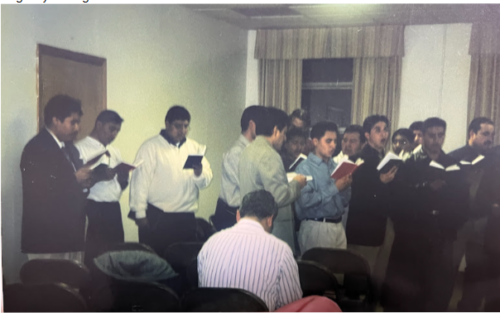
A 2002 New Year’s Eve Service on Grandfield Ave. Courtesy of Aaron Ramirez: 12/31/2002.
Without realizing it, this small group started a migration chain of their own. Each of them brought relatives, in-laws and friends to Bridgeport (both Evangelical and Catholic). Many came via California and New York, hailing from Morelos, Veracruz, Mexico City, and Acapulco, Guerrero.
Organizing Themselves:
Christopher Rosario, as of 2015 the State Representative of District 128 in Bridgeport, recalled:
“My first memory of Mexicans in Bridgeport dates back to the mid to late 1990s. The Puerto Rican community, which I am a part of, did not react negatively to the arrival of Mexicans. Instead, we learned to coexist and appreciate our cultural differences. The Mexican community primarily resided in the Lower Fairfield Avenue of Black Rock and the West Side of Bridgeport. Many Mexicans found work in household services, landscaping, and restaurant services.”
By then, Mexicans were acquainted with every corner of Bridgeport, except for City Hall itself. Many didn’t realize the Mexican community even existed then. Ex-Mayor Bill Finch recalled that:
“The Mexicans sort of snuck up on us. Bridgeport is a melting pot, and Mexicans melted in with the other Latinos. Because Bridgeport had a large Hispanic community, mostly Caribbean… the white population, the majority of Bridgeport, which they are no longer, assumed that because they all spoke Spanish, they were the same”.
But Flores and Casiano, the restaurateur duo, were being motivated by activist Rosa Corera.
Rufino said that “before, everyone dedicated themselves to work”. But Flores said Rosa Correa would tell the two, in a serious tone, how they as Mexicans were missing out on opportunities compared to the Puerto Rican community. She told them to go into a room in City Hall and not leave until they had organized something, and whatever events they did, they’ll do it big time.
From there, Fernando Casiano organized Bridgeport’s first Mexican Independence Day festivities with traveling Mexican folk groups, courtesy of the Mexican consul in New York.
Flores explained that at the time, the governor of Puebla was close with the Mexican consul in New York. “Once, the governor of Puebla sent the folk musicians directly from Puebla to here!”
Caisnao said: “Before, every December 12th, [day of Our Lady of Guadalupe] …we brought mariachis, we celebrated all the holidays. Every September 15th [Mexican Independence Day], … They danced Jarabe Tapatío. We had teams that – a bus came from Mexico, here, they’d arrived on the twelfth, thirteenth of December, here they were on the fifteenth and sixteenth.”
One day, he met Mr. Sampablo, a well-connected immigrant from Puebla living in West Haven.
His son, Refugio Esteban Sampablo Jr, explained how a conversation in 1998 led to an idea.
“Refugio Esteban [Sampablo Sr] knew Don Fernando. He held the September 15th celebrations at the White Eagle Hall in the city of Bridgeport… He brought [Mexican] folk ballet to the city of Bridgeport. Fernando asked Sampablo, “Why is it that every time I invite the Mexican consulate, they never come to the festivities in Bridgeport? From there began the association.”
That was the Mexican Association of Connecticut, which succeeded at its initial goal. Fernando said, “those from the consulate would come to give the cry of independence in Bridgeport”.
It began in 1998 to “to help Mexicans in Connecticut”, with the following Mexican businessmen:
Fernando Casiano and Hugo Macuil (La Poblanita), Alberto Diego (Restaurant Garibaldi and Guelaguetza Grocery), Rufino Flores (La Flor de Mexico Bakery) and Esteban Sampablo Sr.
“They’re all Poblanos, except for [Alberto] Diego Mendoza, who is from Zaachila, Oaxaca”, said Esteban Sampablo Jr. They were also all Bridgeporters, except for Sampablo Sr., who owned Mexico Magico (a notary public service) in West Haven. The group united them for the first time.
In Flores’ words: “At that time we didn’t know each other. There was Sampablo. He was with the consulate… The one who knew more about the organization is Fernando, he headed that…”
Fernando Casiano served as the first president, and meetings were held in Bridgeport. They would meet with city officials often. But he resigned in 2002, when Sampablo Jr. (the son) took over. The meetings moved to West Haven, and focus shifted towards the New Haven area.
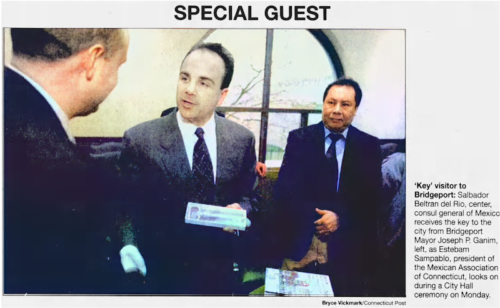
A 3/27/2001 Connecticut Post photo of the Association with Joe Ganim and the Mexican consul
The towns that Poblanos in Bridgeport are largely from, he said, are “from La Trinidad Tepango, Atlixco… also from the Mixteca Poblana, from Cholula, from San Luis Tehuiloyucan, Tehuacán, the majority are from La Mixteca. From Guerrero, there are a lot from Alpuyencancingo”.
For Oaxacans in Bridgeport, one place still stood out. “From Zaachila, the strongest presence”.
And with all this word-of-mouth migration and local births, the Mexican community would grow.
In the 2000 census, Mexicans had surpassed the longer-established Cubans and Colombians as the second largest Hispanic/Latino group in Bridgeport, only behind the Puerto Ricans.
49.3% of them alone were immigrants who arrived in the US between 1990 to March 2000.
There were some 3,000 (counted) Mexicans in Bridgeport, and soon, even thousands more…
NEXT ARTICLE: “When the Aztec Eagle Began Her Soar Over Bridgeport: Part 4 – Three Thousands and Thousands More ”
Bibliography:
U.S. Census Bureau (1990). Connecticut General Population Characteristics, 1990 Census of Population
Retrieved from https://usa.ipums.org/usa/resources/voliii/pubdocs/1990/cp1/cp-1-8.pdf
Pigeonutt, Vania. “Cristina Bautista: 2,555 Días de Dignidad y Amor En Búsqueda.” Amapola, Periodismo Transgresor, 1 Oct. 2021, amapolaperiodismo.com/2021/10/02/cristina-bautista-2-555-dias-de-dignidad-y-amor-en-busqueda/?amp.
Buzzfile Media. “MI Rancho Deli Grocery Store.” Buzzfile. Accessed March 2, 2024. https://www.buzzfile.com/business/MI-Rancho-Deli-Grocery-Store-203-696-0201
.
State of Connecticut. “Business Records Search.” Business.CT.gov. Accessed March 2, 2024. https://service.ct.gov/business/s/onlinebusinesssearch?language=en_US.
X Censo General de Población y Vivienda, 1980. Integración territorial. Estado de Puebla. Tomo 21. N.p.: INEGI, 1990.
X Censo General de Población y Vivienda, 1980. Integración territorial. Estado de Guerrero. Tomo 12. N.p.: INEGI, 1989.
Rodriguez, Daniel. “.Y Nos Fuimos Pal Norte: Migración Internacional, Grupo Doméstico y Remesas Colectivas en Santa Martha Hidalgo, Una Comunidad.” 2008.
Instituto de Los Mexicanos en El Exterior. “Consejo Consultivo de la IME. 2009-2011.”
Varnon, Rob. “Workers Hope for Aid in Closing.” Stamford Advocate, June 25, 2010. https://www.stamfordadvocate.com/business/article/workers-hope-for-aid-in-closing-537957.php
Hernández Corchado, Rodolfo. “Proletarización y Desposesión de Trabajadores Mixtecos: Orígenes de la Migración Indígena a Nueva York.” 2008.
Bollerman, Dan. 1990. “City Soccer Melting Pot of Tounges, Styles.” Connecticut Post (Bridgeport), September 21, 1990, D1. https://www.newspapers.com/image/1252631924/.
Connecticut Post. 1997. “Restaurant Garibaldi.” June 15, 1997, B5. https://www.newspapers.com/image/1243687379/?match=1.
DeMattia, Robert. 1991. “Taste of Turkey Will Be First For These Youngsters.” Connecticut Post (Bridgeport), October 26, 1991, B1. https://www.newspapers.com/image/1251825548/.
Ganga, Elizabeth. 2000. “Census 2000: Stand and Be Counted.” Connecticut Post (Bridgeport), March 14, 2000, A1. https://www.newspapers.com/image/1242803785/.
McDonald, Bill. 1991. “Students Celebrate Cinco de Mayo.” Connecticut Post (Bridgeport), May 4, 1991, B3. https://www.newspapers.com/image/1251810190/.
Richardson, Lydia. 1992. “This Road to New Rochelle Begins in the Hills of Mexico.” The New York Times, July 7, 1992, B1. https://www.nytimes.com/1992/07/07/nyregion/this-road-to-new-rochelle-begins-in-the-hills-of-mexico.html.
Taqueria Mexicana. 2001. “Cooks.” Connecticut Post (Bridgeport), September 16, 2001. https://www.newspapers.com/image/1243290394/.
Thompson, Joel C. 1996. “Bridgeport Stab Victim Critical.” Connecticut (Bridgeport), November 12, 1996, A2. https://www.newspapers.com/image/1241967971/.
Thompson, Joel C. 1998. “Bridgeport Homicide Victim’s ID Still Puzzles Police.” Connecticut Post (Bridgeport), March 27, 1998, A7. https://www.newspapers.com/image/1242084463/.
Walsh, Charles. 1994. “Diet Police May Target Other Foods.” Connecticut Post (Bridgeport), 20 July, 1994, A9. https://www.newspapers.com/image/1242652245/.
Vasquez, Daniel W., “Latinos in Bridgeport, Connecticut” (2003). Gastón Institute Publications. 61. https://scholarworks.umb.edu/gaston_pubs/61
Barrow, Lynda K. 2001. “Mission in Mexico: An evangelical surge.” The Christian Century. https://www.christiancentury.org/article/mission-mexico.
Lambeck, Linda C. 1993. “Student Spotlight: Jose Antonio Moreno.” Connecticut Post (Bridgeport), September 6, 1993.
Ondrey, Anne. 1983. “Teacher: Bilingual Students Do Well.” Bridgeport Telegram, March 9, 1983.